
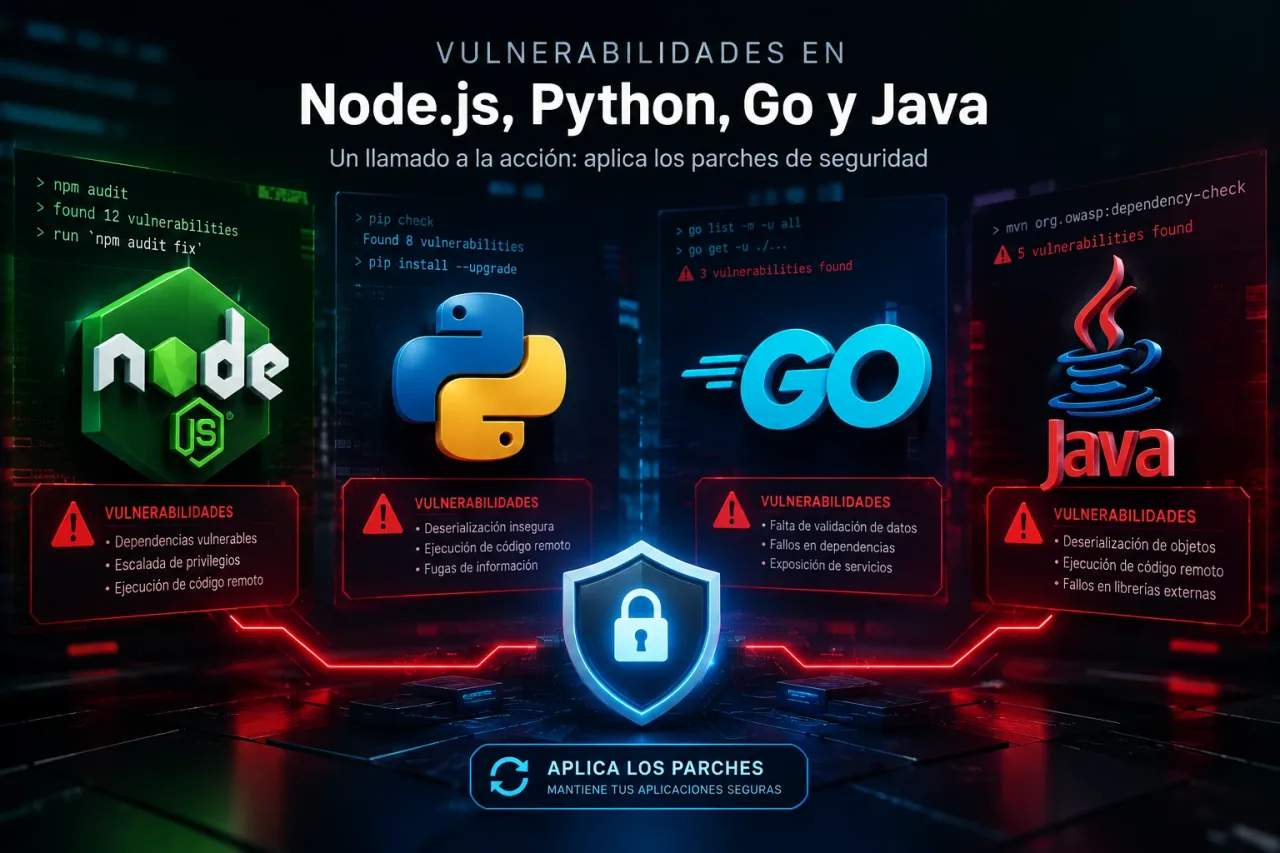
What happened: this week, security patches came out for several languages at once, not only PHP. Node.js has a high-priority advisory for remote code execution and TLS flaws. Java has 49 flaws that can be exploited remotely without authentication. Go and Python have compromised certificates, rated medium priority. What to do today: if you run production applications in any of these languages, review and update them.
Why this week is a bad one for security
When people talk about PHP2Shell, it is easy to assume the problem is only PHP. But this week alerts appeared for several of the most widely used languages on the web and in business. Many sites and tools combine several languages, so a single server can have more than one exposed.
What the advisories say
- Node.js, high priority: remote code execution and TLS (the layer that encrypts connections) flaws.
- Java, high priority: 49 flaws that can be exploited remotely without authentication.
- Go, medium priority: compromised certificates, meaning software signatures that can no longer be trusted.
- Python, medium priority: compromised certificates, with the same kind of risk as Go.
What each one means for your business
Node.js: high priority
Node.js is used in control panels, APIs, automation tools and, increasingly, behind websites. Remote code execution means an attacker can run instructions on the server without having a user account. If you have a Node.js application exposed to the internet, updating it is a priority.
Java: high priority
The 49 flaws without authentication are the most worrying detail this week. Java applications are often integration servers, internal systems or third-party tools that get forgotten on the server. If any of them answers from the internet, any attacker can try it.
Go and Python: medium priority
Compromised certificates are not a flaw in your code, but in the trust placed in packages. The risk is installing software signed with a stolen certificate. So the recommendation is to verify your installations, use only official sources and review which packages were installed in recent weeks.
With remote code execution, the attacker operates with the permissions of the process running the application. They can read what the application can see (including customer data and credentials), modify files, leave a backdoor and use your server to attack others.
How to tell if your site or server is at risk
- Take an inventory. Note which languages and applications run on each server, including control panels, internal tools and third-party services.
- Check the versions with
node -v,java -version,go versionandpython3 --version, and compare them with the fixed versions listed in each official advisory. - Identify what is exposed to the internet. If an application responds from outside, it goes first.
- Ask your provider which runtimes were installed on your account and when they will apply the patches.
What to do today: the checklist
1. Inventory: list the applications and languages on each server. 2. Exposed applications first: update anything running Node.js or Java that answers from the internet. 3. Update Node.js and Java to the fixed version named in each official advisory. 4. Verify Go and Python: reinstall or confirm versions and packages using only official sources. 5. Restart services after updating. 6. Monitor for unexpected file changes or new users in control panels.
Temporary mitigations (while you apply the patch)
If you cannot update right away, the most useful step is to take offline the Java and Node.js applications that do not need to be public, or protect them with a web application firewall (WAF) and access restricted by IP or VPN. These measures reduce exposure but do not replace the update.
The lesson: security is not just about one language. A server running PHP, Node.js, Java and Python needs an inventory and one person responsible for updates across all of them.
Frequently asked questions
If I only use PHP, do I need to worry about Node.js, Java, Go or Python?
If your website or tools use those languages, yes. Many sites combine several: for example, a WordPress site with a Node.js panel, a Python automation service or a Java tool. Check what actually runs on your server.
What does it mean that Java has 49 exploitable flaws without authentication?
It means there are 49 Java flaws that, according to the advisory, can be exploited over the network without credentials. Java applications are often internal servers or third-party tools, so the key is knowing whether any of them is exposed to the internet and updating it.
What is a compromised certificate in Go or Python, and what should I do?
It is a software-signing certificate that someone may have stolen or misused. The risk is installing packages or binaries signed with it. The practical step is to reinstall or verify your Go and Python versions and their modules or packages, using only official sources.
How do I know which Node.js, Java, Go or Python versions I have?
In a terminal: node -v, java -version, go version and python3 --version. On a hosting or control panel, look in the runtimes or applications section. If you are not sure, ask your provider.
Is it the same as with PHP: is updating enough?
Yes, updating to the fixed version is what closes the problem. Temporary measures only reduce exposure while you apply the patch, and you should restart services after updating.
At Digi Team America we take the inventory, apply the updates and verify everything keeps working. Contact us and we will help you today.
Digi Team America
Verified EditorialDigi Team America • AI Growth & Engineering
Specialists in autonomous AI voice agents, conversion websites, CRM pipelines, and local Florida business scaling.